


Description
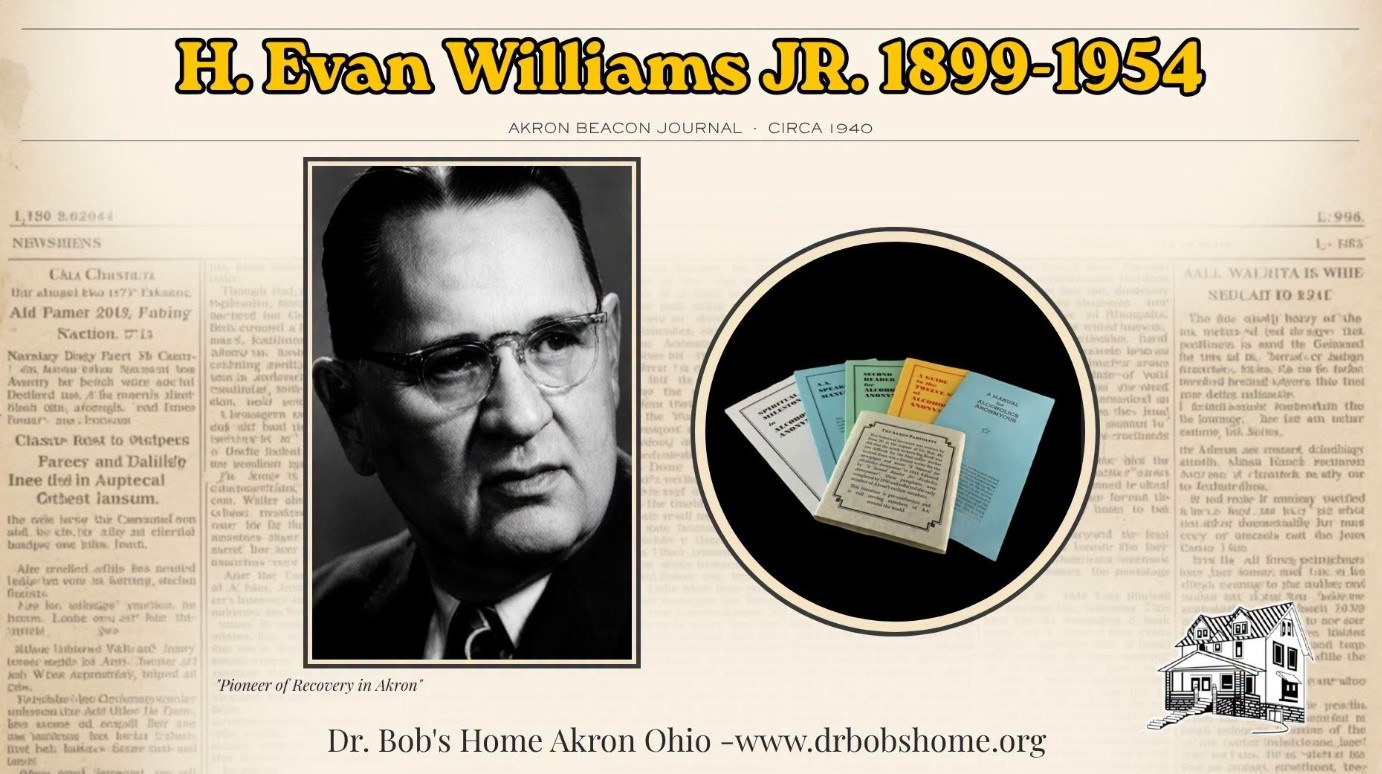
This historical literature was written by Evan W. at the request of Dr. Bob. These 5 pamphlets were completed by 1950 and reflected the early mindset of Akron’s earliest members.
The Man Who Gave Akron A.A. Its Written Voice
Most students of A.A. history knows the names Bill W., Dr. Bob, and Sister Ignatia. Few, however, know the name H. Evan Williams Jr. Yet his writing introduced thousands of alcoholics to the Akron program of recovery during Alcoholics Anonymous’ earliest years.
Born in 1899, Evan Williams was the son of internationally known tenor H. Evan Williams Sr. Rather than following his father into music, Ev became a newspaperman, working for both the Akron Times-Press and the Akron Beacon Journal. His career as a reporter, columnist, and copy editor honed a skill that would later become one of Akron A.A.’s greatest assets—the ability to communicate clearly and simply.
After joining Alcoholics Anonymous in 1940, Williams found a new purpose. Dr. Bob personally asked him to write literature for newcomers. Dr. Bob believed that the newly published Big Book could be difficult reading for many of Akron’s blue-collar workers. He wanted literature that explained the program in plain, understandable language.
The result was A Manual for Alcoholics Anonymous, better known today as the Akron Manual.
Published in 1942, the Manual became one of the earliest instructional guides used by the Akron fellowship. Copies were routinely given to alcoholics admitted to Sister Ignatia’s ward at St. Thomas Hospital, helping newcomers understand the spiritual principles and practical program that had already helped hundreds recover.
What makes the Manual especially significant is that it was not simply one man’s opinion. Its title page states:
“This pamphlet was written and edited by members of Alcoholics Anonymous Group No. 1… The text of this pamphlet has been approved by the membership.”
That statement tells us something important. While Evan Williams was the principal writer, the ideas reflected the collective experience of Akron Group No. 1, including Dr. Bob and many of A.A.’s earliest members. Williams supplied the literary craftsmanship; the fellowship supplied the message.
Over the next several years, Williams continued writing what became known as the Akron Pamphlets, including:
- A Manual for Alcoholics Anonymous
- A Second Reader for Alcoholics Anonymous
- Spiritual Milestones in Alcoholics Anonymous
- A.A. Speakers Manual
- A Guide to the Twelve Steps of Alcoholics Anonymous
These pamphlets were requested by physicians, ministers, hospitals, and A.A. groups across the United States and overseas. In a 1954 editorial following Williams’ death, the Akron Beacon Journal noted that his pamphlets had been sent “to every state in the Union and even to foreign countries.”
The editorial went on to say:
“No one can guess how many individuals have been rehabilitated, how many families have been saved, as a result of Evan Williams’ contribution to Alcoholics Anonymous.”
Williams died on October 13, 1954, at the age of just fifty-five. Like so many early A.A. members, he never sought recognition. His anonymity reflected the very principles he cherished.
History rightly remembers Bill W. as the author of the Big Book. It remembers Dr. Bob as the co-founder of Alcoholics Anonymous. But it should also remember H. Evan Williams Jr.—the gifted Akron newspaperman who, at Dr. Bob’s request, gave the early Akron fellowship its written voice.
His name remained largely unknown.
His words helped carry the Akron message around the world.
________________________________________
Research sources include the 1942 A Manual for Alcoholics Anonymous, the October 1954 Akron Beacon Journal obituary and editorial honoring H. Evan Williams Jr., Gary Neidhardt, Dick B., Jared Lobdell, and other historians of early Akron A.A.


